Let's talk about the number nobody wants to put on the yard sign.

When people ask me what it's like to buy a house in southeastern Wisconsin, they usually start with the price. Fair enough, that's the big one. But the question I wish more buyers asked first is the one that quietly reshapes your monthly payment for as long as you own the place: what are the property taxes?
I'll be straight with you, because that's the whole point of this blog. Wisconsin property taxes are high. There's no soft way to say it, and I'm not going to pretend otherwise to make a sale. But "high" is only half the story, and the half everyone misses is the half that actually decides what you pay. So let's get into it.
Yes, Wisconsin taxes property harder than most states
Here's the baseline. Wisconsin's effective property tax rate on owner-occupied homes runs about 1.32% of a home's value (Tax Foundation, 2026), against a national median closer to 1.02% (Ownwell, 2026). That gap doesn't sound dramatic until you run it on a real house. It's a few hundred to a thousand-plus dollars a year, every year, forever.
Why so high? Wisconsin leans on property taxes to fund schools, counties, and municipalities more than a lot of states do. We don't have the sky-high sales tax or the toll roads some places use instead, so the bill shows up on your home instead of at the register. Whether that's a fair trade is a conversation for a different post, but as a buyer, you just need to know it's baked in.
The thing nobody explains: rate vs. bill
Okay, here's where it gets interesting, and this is the part I end up explaining in person all the time.
The rate (the percentage) and the bill (the actual dollars) do not move together. People assume the "cheap tax" suburb is the one with the lowest rate. Not even close. Watch what happens when you line up the two counties most Milwaukee buyers choose between:
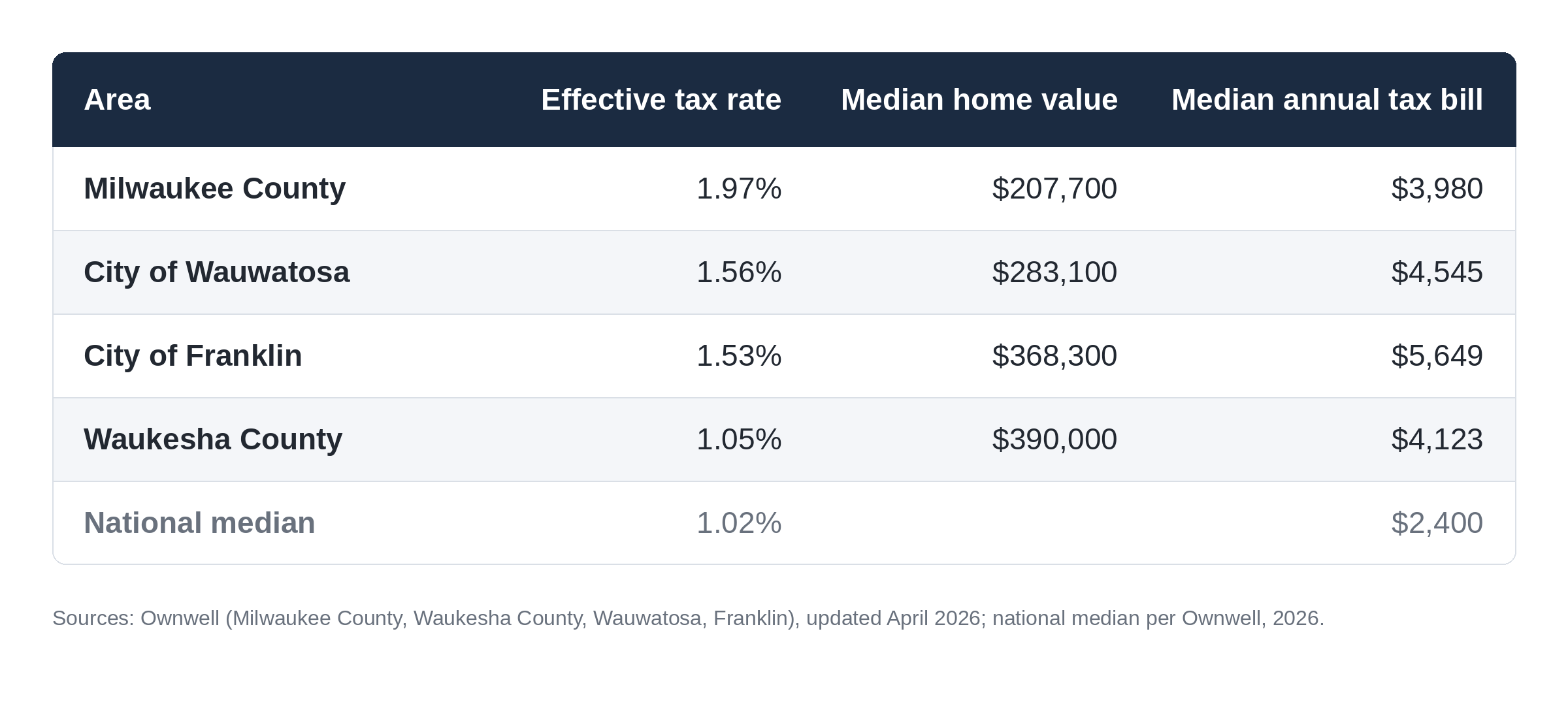
Look at Milwaukee County versus Waukesha County. Milwaukee County has nearly double the effective rate: 1.97% versus 1.05%. If rate were the whole story, Milwaukee would crush you. But the median tax bill in Waukesha County ($4,123) is actually higher than Milwaukee County's ($3,980).
How? Because homes out in Waukesha County cost a lot more. A lower rate on a $390,000 house still writes a bigger check than a higher rate on a $207,700 one. The rate is the speed; the home value is the distance. The bill is what you actually drive.
Franklin's the cleanest example of all. Solid middle-of-the-road rate at 1.53%, lower than Milwaukee, lower than Tosa, and yet the median bill is $5,649, the biggest on this list, purely because the homes are more expensive. So when someone tells you a suburb has "low taxes," your next question should always be: low rate, or low bill? They are not the same thing, and the difference can be a couple thousand dollars a year.
So what does this mean for your monthly payment?
This is the part that sneaks up on first-time buyers. Your property taxes usually get folded into your mortgage payment through escrow. Your lender collects a slice every month and pays the bill for you in December. On a Milwaukee-area home, that escrow line can easily add $330 to $470+ a month to what you owe, on top of principal, interest, and insurance.
Run that math before you fall in love with a house, not after. I've watched buyers get pre-approved on price alone, then feel the payment jump once taxes and insurance land on top. A home that looks affordable on the sticker can get tight once the full PITI (principal, interest, taxes, insurance) shows up. The good news: it's completely predictable. We can pull the exact current tax bill on any property before you write an offer (it's public record), so there are no surprises.
A quick, honest word on mill rates
If you go digging, you'll find "mill rates" published for every city and village: the dollars of tax per $1,000 of assessed value. They're real, but they're a trap if you compare them head-to-head, because every municipality assesses property a little differently and reassesses on different schedules. A town can show a scary-looking mill rate simply because it assesses homes below market value, or a low one right after a revaluation bumped everyone's assessment up.
That's exactly why I lean on the effective rate: tax as a percentage of what the home is actually worth on the open market. It's the only apples-to-apples way to compare St. Francis to Shorewood to Oak Creek. If a listing agent waves a mill rate at you, smile politely and ask for the effective rate instead.
Don't leave money on the table: the credits
Here's the stuff that genuinely lowers your bill, and that a surprising number of homeowners miss.
The Lottery and Gaming Credit. If the home is your primary residence as of January 1, you get a credit funded by, yep, Wisconsin lottery proceeds. It comes right off your tax bill. The catch for buyers: if you close after January 1, the credit may not show up automatically, and you have to claim it. New owners generally need to apply by January 31 after getting the bill, with a late-claim backstop through the Department of Revenue by October 1 of the following year (Wisconsin DOR, 2026). Don't skip this. It's free money you're otherwise leaving on the table.
The First Dollar Credit. A separate credit that applies to any taxable parcel with an improvement on it (basically, a building). This one usually lands on your bill automatically, but it's worth a glance to confirm it's there.
If you're a senior, a veteran, or on a fixed income, there are additional relief programs through the state worth looking into, the Homestead Credit especially. Ask, because nobody's going to volunteer it.
The bottom line from someone who sells here

Wisconsin property taxes are real, and they're higher than a lot of the country. I'm not here to spin that. But "high taxes" is a blunt instrument. The smart move is to look at the actual bill on the actual house you want, factor it into your monthly payment from day one, and claim every credit you're owed.
And honestly? For a lot of my buyers, the taxes are the price of the thing they moved here for: the schools, the parks, the lake, the fact that you can still buy a real house on a normal income. The City of Milwaukee's median sale price was about $225,000 as of late 2025, up a modest 2.3% year over year, with homes going in around 46 days (Redfin, 2025). Compared to where a lot of people are moving from, that's a bargain even with the tax bill stapled to it.
One caveat: these numbers move. Rates get reset, assessments change, and the market shifts month to month. Treat everything here as a 2026 snapshot and check current listings and the actual tax bill on any specific home before you make a decision.
Thinking about buying in Milwaukee, the suburbs, or anywhere in southeastern Wisconsin and want to know what you'd really pay (payment, taxes, and all) on a specific house? Reach out. I'll pull the real tax numbers on any property you're eyeing, no pressure, no sales pitch. That's the part of my job I actually like.
Anthony Loiacono, Keller Williams Southeastern Wisconsin. Written by someone who actually sells here.